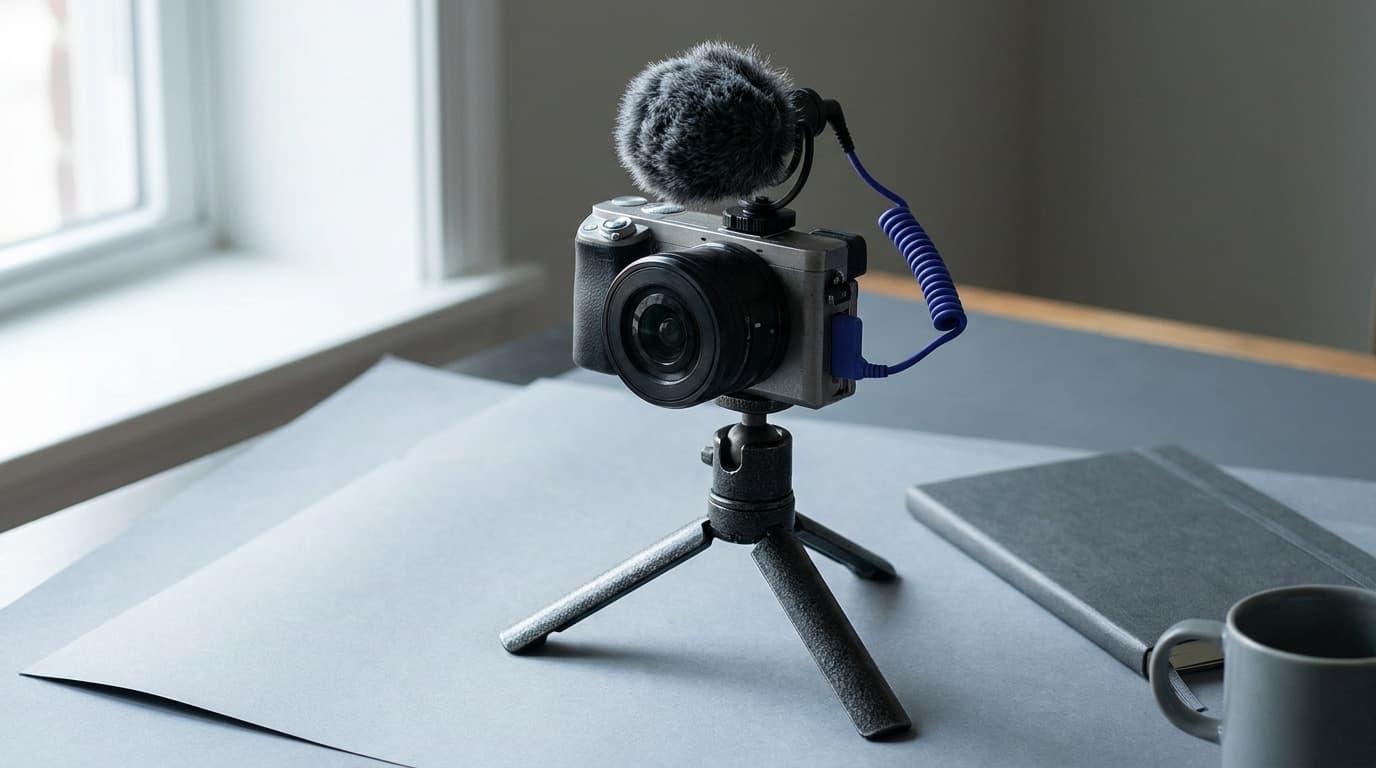
We may earn a commission from links on this page, at no extra cost to you. Picks are researched, not sponsored.
This is the decision behind a lot of first creator kits. One side is a tiny gimbal camera that makes moving footage easy. The other is an APS-C mirrorless body with interchangeable lenses, stronger still-photo range, and more room to grow.
Do not start with specs. Start with the job. If you film yourself walking through a city, a house, a trail, or a trade show, the Pocket 3 solves the hardest part first: stable movement. If you film at a desk, in a studio corner, or around products and want lens choices, the ZV-E10 II makes more sense.
For the broader shopping list, see our best vlogging cameras guide. If the format names are the confusing part, read video codecs, formats, Log, and RAW explained before paying for features you will not use.
The short answer
| Job | Better choice | Why |
|---|---|---|
| Walking and talking | DJI Osmo Pocket 3 | Built-in three-axis mechanical gimbal |
| Desk YouTube setup | Sony ZV-E10 II | Larger APS-C sensor and lens choice |
| Travel with one tiny camera | DJI Osmo Pocket 3 | Pocketable, stabilized, quick to deploy |
| Product videos | Sony ZV-E10 II | Interchangeable lenses and product-showcase autofocus |
| Real estate walkthrough clips | DJI Osmo Pocket 3 | Stable motion with almost no rig |
| Stills plus video | Sony ZV-E10 II | 26 MP APS-C stills and E-mount lenses |
| Beginner simplicity | DJI Osmo Pocket 3 | Fewer parts and fewer settings decisions |
| Long-term system growth | Sony ZV-E10 II | Lenses, mics, lights, support, and upgrade path |
The Pocket 3 is not a worse camera because it has a smaller system around it. That is the point. It removes decisions. The ZV-E10 II is not worse because it needs a lens, card, mic, and support. That is the point too. It becomes what you build around it.
Specs that actually matter
| Spec | DJI Osmo Pocket 3 | Sony ZV-E10 II |
|---|---|---|
| Sensor | 1-inch CMOS | 26 MP APS-C Exmor R CMOS |
| Lens | Fixed wide lens | Sony E-mount interchangeable lenses |
| Stabilization | Built-in three-axis mechanical gimbal | Electronic stabilization, no in-body stabilization |
| Video | Up to 4K/120fps, 10-bit D-Log M and HLG | Up to 4K/60p, 10-bit 4:2:2, S-Log3 and S-Cinetone |
| Audio path | Built-in mics, DJI Mic support | Built-in directional mic, 3.5mm mic input |
| Best practical strength | Smooth motion | Image flexibility |
| Main tradeoff | Fixed lens and small controls | Needs more kit around it |
DJI lists the Osmo Pocket 3 with a 1-inch CMOS sensor, 4K/120fps, three-axis mechanical stabilization, and 10-bit D-Log M plus HLG. Sony lists the ZV-E10 II with a 26 MP APS-C sensor, E-mount, 4K recording up to 60p, 10-bit 4:2:2 options, S-Log3, and S-Cinetone. Those specs point to different jobs, not one obvious winner.
Pick the DJI Osmo Pocket 3 if movement and U.S. value are the point
Best U.S. Value
DJI Osmo Pocket 3
U.S. buyers who want a proven, lower-cost pocket gimbal with official domestic retail support.
Check price at AmazonThe Pocket 3 wins when the camera moves with you. Walking footage is where small mirrorless bodies often get ugly unless you add a gimbal, crop heavily with digital stabilization, or move very carefully. The Pocket 3 has the gimbal built in, which means a beginner can get usable movement without building a rig.
It also has the right kind of friction for travel. The camera comes out fast, the screen rotates forward, and the whole setup disappears into a pocket. That matters more than a spreadsheet if the alternative is leaving a larger camera in a bag.
The tradeoff is creative control. You cannot swap to a portrait lens, macro lens, or fast prime. You get one small camera with one lens and a tiny body. If your channel depends on shallow backgrounds, product closeups, or changing focal lengths, the Pocket 3 eventually feels boxed in.
Pick the Sony ZV-E10 II if you want a creator system
Best Lens System Step-Up
Sony ZV-E10 II
Vloggers and content creators who want interchangeable lenses without a viewfinder.
Check price at AmazonThe ZV-E10 II wins when the camera is the center of a growing kit. The APS-C sensor gives you more background blur and still-photo flexibility than the Pocket 3. E-mount gives you wide lenses for arm's-length work, fast primes for talking heads, and macro or telephoto options when the channel expands.
It is also the better choice if you want one camera for YouTube, thumbnails, product photos, family photos, and travel stills. The Pocket 3 is a video-first movement tool. The ZV-E10 II is a real interchangeable-lens camera shaped for creators.
The tradeoff is that it is not magically smooth. There is no in-body stabilization, so handheld walking clips need discipline, a stabilized lens, digital stabilization, or a separate gimbal. If you are trying to film walking tours every week, the Pocket 3 is the cleaner answer.
The hidden cost is not the camera body
The Pocket 3 asks for fewer accessories. A sensible kit is the camera, a memory card, maybe DJI Mic, and a small handle or mini tripod. The ZV-E10 II asks for a lens, a card, a microphone, a tripod or grip, and maybe a light. That is not bad, but it changes the budget.
If you buy the ZV-E10 II because it looks only a few hundred dollars more than the Pocket 3, include the lens and audio path before deciding. If you buy the Pocket 3 because it is cheaper, make sure the fixed lens will not be the thing you outgrow in two months.
Which one should most beginners buy?
Beginners filming movement can still justify Pocket 3 when its U.S. price is clearly below current alternatives. It solves stabilization, size, and setup speed in one move. Beginners filming planned videos should buy the ZV-E10 II, especially if they also care about stills or want to learn lenses.
The deciding question is simple: will the camera be moving most of the time?
If yes, compare the Pocket 3 price with Luna Ultra and Pocket 4 first. If no, choose ZV-E10 II.
What to read next
Use the best vlogging cameras guide if you still want to compare Canon, Fujifilm, Panasonic, Sony, and DJI options. Use the Gear Finder if you want a camera list filtered around budget and workflow. Once the body is chosen, finish the kit with microphones for video, memory cards, and small video lights.
Is the DJI Osmo Pocket 3 better than the Sony ZV-E10 II?
Only for the right job. The Osmo Pocket 3 is better for smooth walking footage and a tiny travel setup. The Sony ZV-E10 II is better for lens choice, stills, talking-head videos, product shots, and long-term system growth.
Can the Sony ZV-E10 II replace the Osmo Pocket 3?
It can replace it for planned videos, desk videos, product work, and general hybrid shooting. It does not replace the Pocket 3 as cleanly for walking footage unless you add a gimbal or accept a more cropped, digitally stabilized look.
Do I need 10-bit Log video for vlogging?
No. It helps if you plan to color grade. If you want quick clips with normal color, standard profiles are easier. Read the codecs and Log explainer before making 10-bit the deciding feature.
Which camera is better for real estate video clips?
The DJI Osmo Pocket 3 is usually better for simple walkthrough motion. For polished paid work, a mirrorless body on a gimbal gives more control, but it also adds setup time and cost.
Sources: DJI Osmo Pocket 3 official specs, DJI Osmo Pocket 4 official announcement, Sony ZV-E10 II official specifications.
Related Gear guides
Best Budget Lenses in 2026: Current Picks by Camera Mount
Choose an affordable lens by camera mount and shooting job, with current-model checks and a price note for Canon's RF 50mm f/1.8.
Best Camera Bags in 2026: Backpacks, Slings, and Travel Picks
The right camera bag protects your gear, gives fast access, and is comfortable to carry. Here are the best backpacks, slings, and travel bags, with who each suits.
Best Cameras for Beginners in 2026: First Interchangeable-Lens Picks
The best beginner cameras balance an easy interface, good autofocus, and room to grow. Here are six we recommend and how to pick the right first body.
Best Cameras Under $1000 in 2026: Beginner, Value, and Creator Picks
The best cameras under $1000 deliver strong autofocus and image quality without the full-frame price. Here are six picks and how to choose the right one.
Researched, not personally tested: picks compare specifications, available owner feedback, and established expert sources. As an Amazon Associate I earn from qualifying purchases. We may earn a commission from links here, at no extra cost to you. How we research →